
The innovators Advantage
Why Some Companies Create New Categories While Others Optimise Existing Ones: June 2026
Aragon Research recognised RPost as a leader in Digital Transaction Management for the third consecutive year, naming the company both a leader in DTM and in Preventive Intelligent Content Security (PICS), and the most innovative company in its segment.
This led me to think: why do some organisations consistently identify opportunities that others overlook?
Renowned economist Joseph Schumpeter argued that economic growth does not come merely from efficient resource allocation. It comes from new combinations:
1. New products.
2. New business models.
3. New markets.
4. New technologies.
5. New ways of solving problems.
But how to combine to create new product categories?
Innovation Begins With Anomalies
Every strategic option begins with observing and identifying an anomaly.
It does not begin with a question, a strategy session, or a brainstorming exercise. It begins with an anomaly: something that should not be happening, but is.
Scientists rarely begin with "What question should I ask?" They begin with "something doesn't make sense." A disease behaves differently than expected. An experiment produces a result the model cannot explain. Mr Xerxes Desai identified the anomaly that European watches were being smuggled into India. It did not align with his mental model of how things should be, which led him to found Titan Industries.
The identification of an anomaly precedes the question of what we should build, which in turn leads to possibilities and solutions. Instead of beginning with solutions and then seeking problems to justify them, a more rigorous discipline is to start with what does not fit and pursue that discomfort until it evolves into a meaningful question.
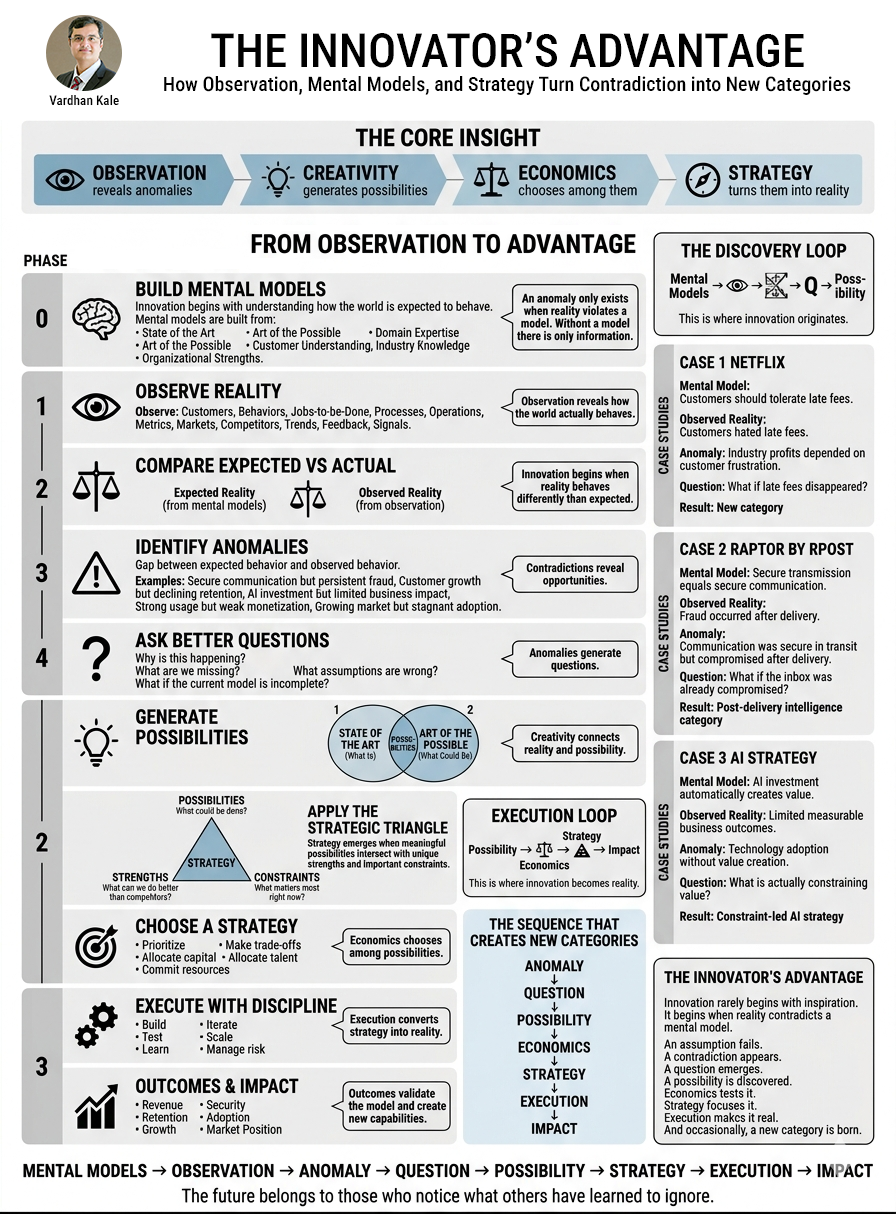
Anomaly → Question → Possibility → Economics → Strategy
This is why Rumelt, in Good Strategy Bad Strategy, insists that diagnosis precedes everything else. You cannot design a coherent strategy around a problem you have not yet correctly identified.
The state of the art shows what currently exists. The art of the possible shows what could exist. One needs the patience to look at the current situation and ask: Is this how it should be?
Observation reveals anomalies. Creativity generates possibilities. Economics selects among them. Strategy converts them into reality.
Without observation and anomaly, creativity lacks direction. Without economics, possibilities remain aspirational. Without strategy, resources lack focus.
Omitting any step breaks the sequence. Initiating with solutions before understanding the problem leads to optimising the wrong outcome. Generating possibilities without economic discipline produces ideas that never materialise as products. Applying economics before strategy results in the allocation of productive resources to inappropriate objectives.
Sustainable advantage requires the full sequence in the right order.
A Story About Two Companies Looking at the Same Information
In 1999, Blockbuster and Netflix were looking at identical information. But one of them was paying attention to an anomaly.
Customers hated late fees. They complained about them, resented them, built their viewing habits around avoiding them. Yet the entire industry depended on them — late fees contributed roughly 16% of Blockbuster's annual income. A business model built on something customers actively disliked was not a stable equilibrium. It was a tension waiting to be resolved.
Blockbuster noticed the tension and chose to manage it. Netflix noticed the same tension and asked a different question: what if the thing the customer hates most is also the thing we could remove entirely?
The second question is not economic; it is imaginative.
This represents the true function of creativity: not inventing, but recombining existing signals in novel ways. Blockbuster optimised within its existing options, whereas Netflix first expanded its options and then optimised. The sequence is critical.
Once Netflix had the creative insight — eliminate the friction customers resent, replace late-fee revenue with subscription economics — economics entered the picture. Resources were finite. Capabilities had to be built. The creative possibility had to be tested against the constraint of what was actually executable with available capital and talent.
The Strategic Triangle
At its foundation, every strategy emerges from the interaction of three forces.
Possibilities determine what could be done. Strengths determine what a company can do better than others. Constraints determine what matters most.
Strategy results from the interaction of these forces. A company that understands its constraints but ignores its strengths will reach the same solutions as others, since the constraint is shared, and undifferentiated responses lead to similar outcomes. Conversely, a company that knows its strengths but ignores constraints may pursue interesting but economically irrelevant opportunities.
Strategy is effective when the organisation's unique strengths are applied to meaningful constraints (deliberate choices) to realise a possibility that competitors have yet to recognise. That's why strategy is not a plan; it emerges from a structured interaction among imagination, capability, and reality.
The remaining question is: where do possibilities come from in the first place? Possibilities do not emerge randomly. They emerge when reality violates a mental model. The anomaly creates the question. The question creates the possibility. Without anomalies, strategy becomes an exercise in choosing among existing options. With anomalies, entirely new options become visible.
Why Constraints Alone Do Not Explain Innovation
If constraints alone created strategy, every company facing the same constraint would arrive at the same solution.
This is not the case.
The differentiating factor is organisational strengths and the creative questions that only a specific combination of strengths can enable.
Consider the email security industry. Every company in the space faced the same constraint: email is insecure, and the consequences of a compromised message are severe. The industry organised itself around one question: how do we secure email in transit?
Encryption providers enhanced encryption. Gateway vendors improved filtering. Security platforms advanced detection. Each solution was a more sophisticated answer to the same question. The constraint was shared, the response convergent, and the category became a competition of execution rather than imagination.
RPost noticed a different anomaly.
Emails were being delivered securely. Encryption was working. Gateway filters were catching known threats. And yet fraud was still occurring. A title insurance company lost money. A transaction was compromised. The investigation revealed that the problem had not occurred in transit — it had occurred after delivery. The inbox itself had been compromised before the message arrived.
The existing model said that securing messages in transit ensured safe communication. Reality said otherwise. That gap — between what the security model predicted and what fraud patterns indicated — was the anomaly. And it was the anomaly, not a strategy session, that prompted RPost to build a product around.
For over two decades, the company has accumulated expertise not just in email delivery but also in forensic evidence, message tracking, recipient behaviour, and digital chain of custody. These capabilities, often invisible to those observing only the market's surface as strategic assets, enabled the company to perceive opportunities others could not.
What if the most important security question was not whether the email was delivered securely, but whether the recipient's inbox had already been compromised before the message was delivered? What if the attacker places themself between the victim and the website by using MFA-bypass tactics with phishing-as-a-service kits such as EvilProxy, Tycoon 2FA, and Sneaky 2FA? What if a company protects itself, but its small suppliers and vendors with whome it shares payment links and invoices don't?
This reframes the problem. Rather than focusing on message transmission, attention moves to post-delivery events. If a sensitive message is accessed from a suspicious location, by an unexpected user, or under conditions indicating compromise, the system can intervene. The threat thus becomes a post-delivery forensic issue, calling for a new product category, specialised expertise, and a distinct value proposition.
The innovation is not a better answer to the industry's existing question; it is a response to a fundamentally different question.
The constraint was common to all competitors. The possibility—that post-delivery behaviour represents the main risk—was observable to any attentive party. However, the two decades of accumulated forensic capability and recipient intelligence were unique, making the alternative question not only worth asking but equally actionable.
That is the Strategic Triangle in practice. Shared constraint. Common possibility. Unique strength. Different question. New category.
Disruption occurs not through superior resources or execution, but by asking the questions others overlook.
Observation Is Not Enough. Mental models matter.
Innovation relies on two capabilities: careful observation and robust mental models. Observation reveals reality, while mental models indicate when reality deviates from expectations.
This explains why deep domain expertise frequently precedes breakthrough innovation. The innovator does not simply observe reality; they continuously compare reality against a detailed internal model of expected behaviour. When the model and reality diverge, the expert immediately recognises the discrepancy as a violation that must be fixed.
Blockbuster's leadership knew customers disliked late fees, but for them, this alone was not an anomaly; discomfort is common across industries. The anomaly appeared only when compared with a different mental model: a business built on customer resentment is unstable. Netflix recognised this; Blockbuster did not.
RPost noticed fraud after secure delivery, not because fraud was unusual, but because their model assumed secure transmission meant secure communication. Reality violated the model. That violation — invisible to competitors who lacked such a model — became the question that created a new category.
The stronger the mental model, the easier it becomes. Years of deep domain expertise cultivate more than knowledge; they establish a finely tuned expectation of system behaviour and a sensitivity to deviations.
Mental Models + Observation → Anomaly → Question → Possibility → Economics → Strategy
The innovator's primary responsibility is not to generate ideas, but to construct models sufficiently robust that contradictions with reality become impossible to overlook.
What Product Leaders Can Learn
Prioritisation is not the primary responsibility of a product leader. It is the final one.
They should ask the question: How can I improve my ability to notice anomalies?
The anomalies are already present in every organisation. Customers who should be satisfied but are leaving. Products that should be working but are generating complaints. Markets that should be growing but are stagnant. Strategies that analysts praise, but execution keeps undermining.
The key is not to rationalise these tensions, assimilate them into the existing model, or dismiss them as noise. The more demanding discipline is to pause, inquire into the anomaly's existence, and pursue that question until it is resolved or reveals a limitation in the current model.
The popular image of innovation is a flash of inspiration. In reality, the idea is rarely the first step. Anomalies identified and resolved at the User Interface, System Design, and Architecture levels create incremental innovation. Anomalies are identified through disciplined investigation of customers' problems and by recognising what fits, thereby creating new categories.
Organisations regarded as innovative are not inherently more creative than others. They are often superior observers, constructing richer models of the world, identifying contradictions earlier, taking anomalies seriously, and demonstrating the discipline to pursue anomalies wherever they lead.
In the end, innovation begins neither with technology nor with creativity. It begins with seeing something that should not be true — and refusing to look away.
Did this fit into your mental model? Did you find any anomaly? Happy to know your views. Let me know in the comments in my LinkedIn post: Post | LinkedIn
This work began unexpectedly. While teaching economics to my son, I started writing an essay on how the first principles of economics apply to business and product management. That article evolved into a framework for constraint-based decision-making and eventually led to several more essays.
RPost CEO Zafar Khan suggested that constraints alone do not explain how entirely new product categories come into existence, which nudged me to shift focus from constraints to growing the pie and explore the relationship between creativity, economics, and strategy more deeply, ultimately leading to this article and infographic. He was the force behind the innovations that I shared in this article. My thanks to him for the intellectual nudge.
I hope this framework helps others—whether product managers, founders, executives, students, or even parents trying to explain innovation to their children.
Acknowledgements


Vardhan is currently serving as a senior product manager at RPost. He brings innovative ideas to life by designing enterprise applications and creating experiences that delight end users. Over the past two years, RPost products have earned multiple awards and industry recognition for innovation, solidifying their position in the Leaders Quadrant of leading analyst reports
Read more here.